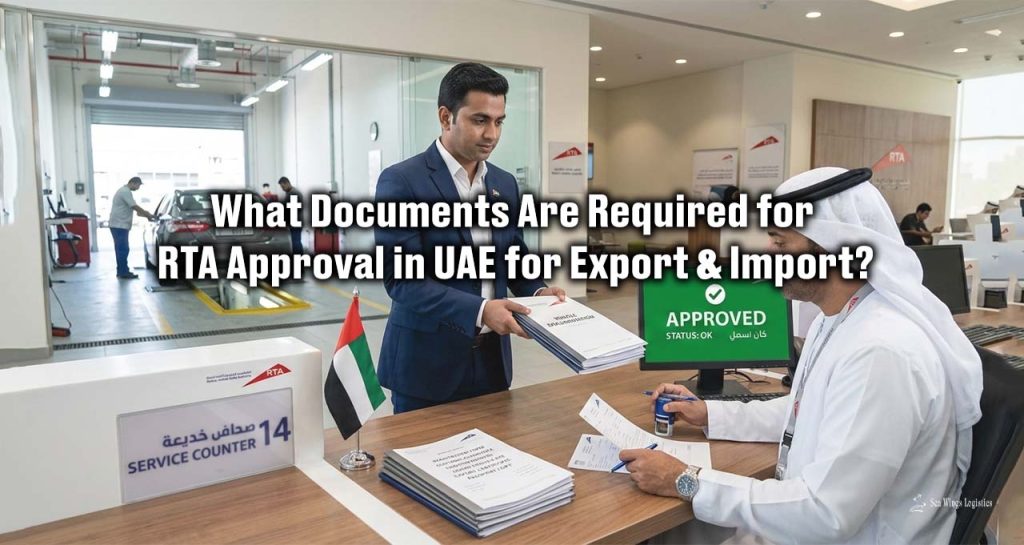
When handling export and import shipments in the UAE, most businesses focus on customs clearance and shipping documents. However, another important requirement is RTA approval for commercial transport.
If goods are moved using commercial vehicles — especially heavy trucks, trailers, or modified vehicles — approval from the Roads and Transport Authority (RTA) may be required. Understanding what documents are required for RTA approval in UAE for export and import helps avoid delays, fines, and operational issues.
What Is RTA Approval?
The Roads and Transport Authority (RTA) is responsible for managing roads, traffic, and commercial vehicle regulations in the UAE.
RTA approval is official permission that allows commercial vehicles to operate legally on UAE roads. It is often required for:
- Commercial vehicle registration
- Road permits
- Heavy cargo transport
- Oversized machinery movement
- Modified vehicles
- Transport to ports and airports
For export and import businesses, this approval ensures that cargo is transported safely and legally.
Why Is RTA Approval Important for Export and Import?
When goods are transported to seaports, airports, free zones, or warehouses, the vehicles used must meet road safety and legal requirements.
RTA approval helps ensure:
- Legal road use
- Valid vehicle registration
- Proper commercial insurance
- Approved heavy cargo movement
- Safe transportation of machinery and equipment
Without proper approval, vehicles may face penalties or be stopped during transport.
Table of Contents
Who May Need RTA Approval?
RTA approval may apply to:
- Exporters moving goods to ports
- Importers transporting heavy equipment
- Freight forwarders
- Transport operators
- Heavy truck and trailer operators
- Businesses moving construction machinery
If commercial vehicles are used for export or import cargo, RTA documentation may be required.
Main Documents Required for RTA Approval
The required documents depend on the vehicle type and cargo weight. Below are the most common documents needed.
1. Trade License Copy
This proves the business is legally registered in the UAE.
The trade license must be valid and include the correct business activity.
Common issue: Expired license or incorrect activity listed.
2. Emirates ID
The Emirates ID verifies the identity of the owner or authorized person.
It must be valid at the time of application.
Common issue: Expired ID.
3. Passport Copy with Valid Visa
This confirms residency status in the UAE.
The visa page must be included.
Common issue: Missing visa page.
4. Vehicle Registration Card (Mulkiya)
This shows vehicle ownership and registration details.
It must be valid and updated.
Common issue: Expired registration or incorrect vehicle details.
5. Commercial Vehicle Insurance
The vehicle must have valid insurance that covers commercial use.
Common issue: Insurance not covering commercial activity or expired policy.
6. Technical Inspection Certificate
Commercial and heavy vehicles must pass inspection to confirm road safety.
Inspection is required for:
- Heavy trucks
- Trailers
- Modified vehicles
- Permit renewals
Common issue: Failed inspection or outdated certificate.
7. No Objection Certificate (NOC)
If the vehicle is financed or leased, an NOC from the bank or leasing authority is required.
Common issue: Missing NOC.
8. Export and Import Cargo Documents
For cargo-related approvals, the following may also be required:
- Commercial invoice
- Packing list
- Bill of lading (sea shipments)
- Air waybill (air shipments)
- Delivery order
- Customs declaration
These documents confirm cargo type, weight, and destination.
9. Load Details
Load details include:
- Cargo weight
- Dimensions
- Description
This is important for heavy or oversized shipments.
Common issue: Incorrect weight information.
10. Route Plan
For oversized or heavy cargo, a route plan may be required to ensure safe road usage.
Common issue: Using restricted roads.
11. Authorization Letter and Company Stamp
An authorization letter confirms that the application is officially submitted by the business.
It must be signed and stamped.
Common issue: Missing signature or stamp.
Summary Table of Required Documents
Document | Purpose | Mandatory / Conditional |
Trade License | Business verification | Mandatory |
Emirates ID | Identity verification | Mandatory |
Passport & Visa | Residency proof | Mandatory |
Vehicle Registration | Ownership proof | Mandatory |
Commercial Insurance | Risk coverage | Mandatory |
Technical Inspection | Road safety compliance | Mandatory |
NOC | Ownership clearance | Conditional |
Commercial Invoice | Cargo confirmation | Conditional |
Packing List | Cargo details | Conditional |
Load Details | Weight compliance | Conditional |
Route Plan | Safe transport approval | Conditional |
Authorization Letter | Official submission | Mandatory |
Common Reasons for Rejection
RTA applications may be delayed or rejected due to:
- Expired trade license
- Invalid insurance
- Missing NOC
- Incorrect vehicle details
- Failed inspection
- Wrong cargo weight declaration
- Missing route approval
Checking all documents carefully helps avoid delays.
Understanding what documents are required for RTA approval in UAE for export and import is important for smooth cargo transport.
The key documents usually include:
- Trade license
- Emirates ID
- Passport and visa copy
- Vehicle registration
- Commercial insurance
- Technical inspection certificate
- Cargo documents
- Load details and route plan (if required)
Complete and accurate documentation helps ensure safe and legal transport operations.
We provide RTA Approval service in UAE. SEA WINGS LOGISTICS has been in business since 2009 in Dubai, UAE. We are a full-fledged forwarding company providing services and Customs Approvals also.