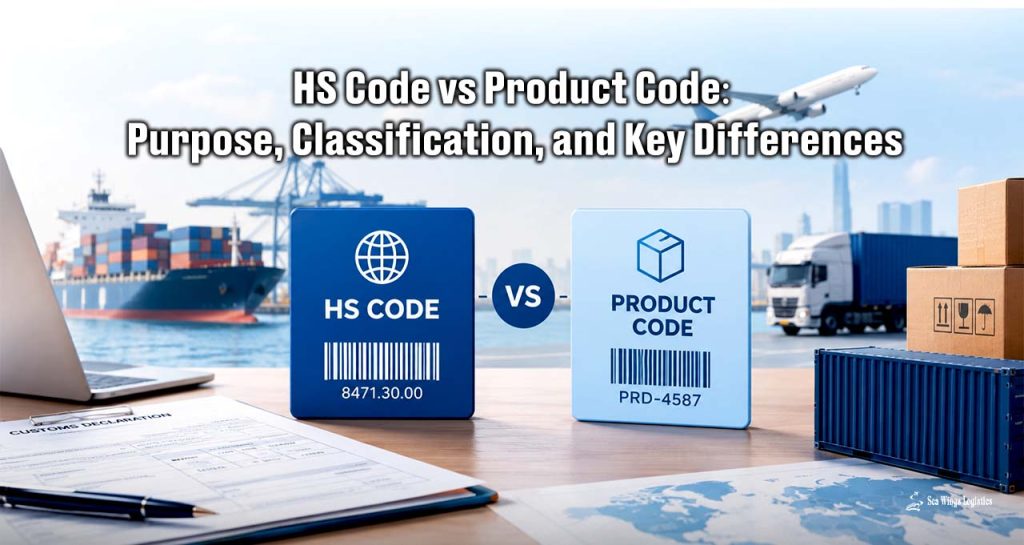
When shipping goods internationally, you may come across two types of codes: HS codes and product codes. Although they may look similar, they serve different purposes. Understanding the difference helps businesses manage products, prepare shipping documents, and support smooth customs clearance.
In this guide, we explain HS codes and product codes with simple examples.
What Is an HS Code?
An HS code (Harmonized System code) is a code used to classify goods in international trade. Customs authorities use it to identify products and determine applicable import duties, taxes, and regulations.
The international HS system uses six digits. Some countries add more digits for their national customs requirements.
Example: A business exporting wooden furniture needs to identify the correct HS code based on the furniture’s materials, design, and applicable classification rules.
HS codes help businesses:
- Classify goods for customs clearance.
- Determine applicable duties and taxes.
- Identify relevant import and export requirements.
- Prepare shipping and customs documents.
Table of Contents
What Is a Product Code?
A product code is an identifier used by a business to manage and track its products. It helps with inventory, sales, ordering, and warehouse operations.
Businesses can create their own product codes based on their needs.
Example: A furniture company may use TBL-001 for a wooden table and CHR-001 for a chair.
Product codes help businesses identify specific items, but they do not replace HS codes for customs purposes.
HS Code vs Product Code: Key Differences
Feature | HS Code | Product Code |
Purpose | Classifies goods for international trade | Identifies products for business use |
Used by | Customs authorities, importers, and exporters | Manufacturers, retailers, and businesses |
Format | Six international digits, with possible country-specific extensions | Varies by business or system |
Main use | Customs classification and trade requirements | Inventory and product management |
Example | An HS classification for a wooden table | TBL-001 for a specific table model |
The main difference: An HS code classifies goods for international trade, while a product code helps businesses identify and manage individual products.
Note: HS code examples should be verified against the product details and the importing country’s official tariff system before use.
How Are HS Codes and Product Codes Used in Shipping?
Imagine a company exporting wooden tables from Dubai, UAE.
- Product code: The company uses TBL-001 to identify a particular table model in its inventory.
- HS code: The company determines the appropriate HS classification for the table based on its materials and characteristics.
- Shipping documents: The company provides an accurate product description and the required customs information.
- Customs clearance: Customs authorities use the HS code and other shipment details to assess the goods.
This example shows how both codes can be used for the same product but serve different purposes.
Frequently Asked Questions
No. An HS code classifies goods for international trade, while a product code identifies items for business operations.
No, when customs procedures require an HS code. An internal product code does not replace the required customs classification.
The international HS system uses six digits. Some countries add more digits to meet national tariff requirements.
Yes. Businesses can assign different internal codes to the same type of product. However, the correct HS classification must be determined according to the applicable customs rules.
International Shipping Support with Sea Wings Logistics
Understanding HS codes and product codes helps businesses prepare shipping documents and manage international cargo more effectively.
Sea Wings Logistics LLC, based in Dubai, UAE, has been in business since 2009 and supports commercial cargo movements through sea freight, air freight, land transport, and customs coordination.
Planning an import or export shipment? Contact Sea Wings Logistics to discuss your commercial cargo requirements.